
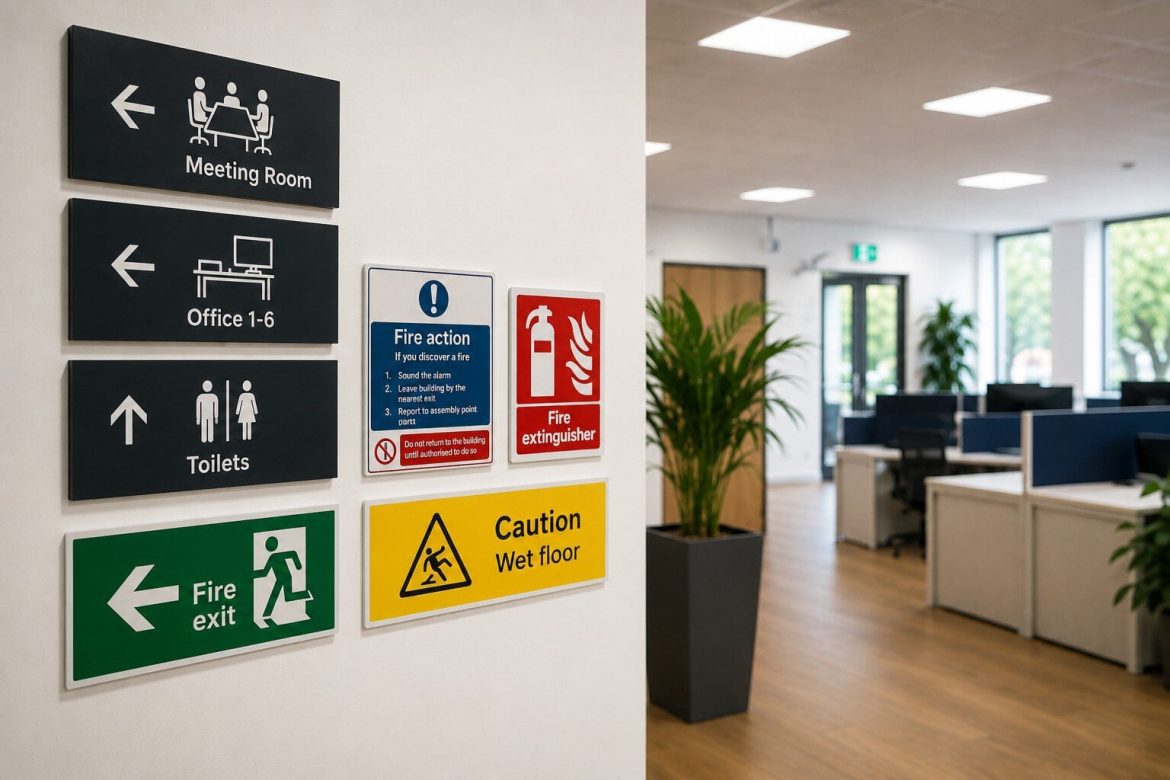
When setting up or reviewing a workplace, signage is often one of the last things considered – but it actually plays an essential role in how a space functions on a day-to-day basis.
Clear, well-positioned signage supports safety, helps people move around a building confidently and ensures that businesses meet their legal responsibilities. While it may not be the most visible part of an office setup, it is one of the most important.
Workplace signage
In any commercial environment, signage provides guidance and reassurance. Employees, visitors and contractors all rely on it – although often without consciously noticing it.
In practical terms, signage helps people to:
- Identify emergency exits quickly
- Navigate unfamiliar buildings
- Locate facilities such as toilets or meeting rooms
- Understand safety instructions
- Door identification signage (durable signs on office doors)
- Signholders – reception desk (deflecto sign holders)
Without clear signage, even a well-designed office can feel confusing or difficult to use.
Workplace legal and safety requirements
Depending on your risk assessments and industry needs, certain types of signage are not optional. Fire exit signage, health and safety posters and health hazards are often required to ensure compliance with regulations.
These signs need to be:
- Clearly visible
- Positioned correctly
- Maintained over time
Failing to provide adequate signage can create risks in emergency situations, which is why it is important to plan signage when setting up or updating a workspace and review it regularly to ensure it still meets your needs.
Of course, essential signage isn’t always fixed to a wall – something as simple as a wet floor sign is an everyday workplace necessity that needs to be there when you need it.
Planning office signage
Signage is most effective when it is considered alongside the overall layout of a space. Rather than adding signs at the end of a project, it is often better to think about them during the planning stage.
This allows businesses to ensure that signage:
- supports natural movement through the space
- is consistent in design and positioning
Taking this approach helps avoid gaps or inconsistencies later.
Setting up new office premises
For many businesses, particularly those setting up new premises, it can be difficult to know exactly what signage is required – there are a wide variety, from CCTV notification signage to No Entry and Smoking direction.
This is where a structured approach can help. Reviewing the space properly ensures that all necessary signs are in place, from safety requirements through to general workplace guidance – office furniture teams like ours can support you in this.
While signage may seem like a small detail, it is one that creates safe and effective use of a workspace every day.
Office signage FAQs
What signs are required in an office building?
Most offices require fire exit signs, emergency exit route signage and health and safety notices. Additional signage may be needed depending on the building layout and usage.
Where should fire exit signs be placed?
They should be positioned clearly along all fire escape routes, ensuring they are visible and easy to follow in an emergency, in line with your Fire Risk Assessment.
Does a small businesses need office safety signage?
Yes. Regardless of size, businesses must ensure that appropriate safety signage is in place where required.
What signage does my office need?
Reviewing the layout of your building and its usage will help identify requirements as well as reviewing your Fire Risk Assessment and any health and safety policies.